
Book Review: Programming and Meta-Programming in the Human Biocomputer
Commentary and meta-commentary on Dr. Lilly's most confounding work
When I was starting my junior year at Cal, I realized that despite being a computer science major, I wasn’t doing much computer science. I had plenty of good excuses for this: I had started college intending to study political science; in service of that end, I had joined some clubs, but they had nothing to do with programming; I had barely eked into declaring the major at all, thanks in part to an eleventh-hour use of the late-drop form; and I had embarked on a lucrative career washing dishes at the dining hall. But by far the biggest hurdle standing between me and extracurricular programming was the CS club applications themselves. Due to the overwhelming number of fellow travelers1 all trying to get into the same clubs and improve their future résumés, the applications had become gauntlets, and applicants were frequently expected to have prior experience (which seems sort of self-defeating in retrospect). All the CS clubs, that is, but one: the Open Computing Facility, a computer lab in the basement of the student union, best known as “the place you can print for free”, which accepted all newcomers with open arms.
At my first OCF meeting, I met my mentor, a scruffy senior named Abizer. I didn’t know him long2, but he still managed to completely blow my mind twice. The first time was when he introduced me to a dealer for an insanely concentrated cold-brew coffee concoction, of which one shot was equivalent to two full cups of coffee, which somehow maintained the tasting notes of the original and wasn’t disgustingly bitter — I digress, but I wish I remembered where to find it! Anyways, the second time was when he sent me a PDF of Programming and Metaprogramming in the Human Biocomputer.
Before I dissect this work (and its author), I want to stop and make clear the effect it had on me. I’d began studying computer science on something of a whim; it seemed interesting, but more to the point, I’d heard the intro class had a reputation as a notoriously difficult “weeder”, and I wanted to measure my abilities against the challenge. I found that I was good at programming, and figured it was just as good a field of study as any other, so I pursued it further, but with very little “academic” rationale. The closest thing I had to a research goal at first was to understand how we got from sand to Python, how we captured lightning into rock and forced it to think — but it turns out you get through most of that in the intro sequence, so by the time I found myself in the OCF I mostly was just hoping to find an internship for the summer. This book rejuvenated my academic spirit, although I didn’t know it at the time. I was far too busy being floored by the psychedelic insanity of Dr. Lilly’s scientific “method”. You mean to tell me, this guy invented the sensory deprivation tank, so he could crawl in there and take acid? And his trip report is arguing that my brain, my self, the very thing that makes me “me”, is a computer? How does that even make sense? How could a computer simulate the subjective nature of human experience? Where would that leave my free will?
But as I found in the years to come, the idea, neither as ludicrous as the method by which it was reached nor the man who reached it, is infectiously captivating. It is the smoldering flame which has sustained my academic spark in my post-college years in industry.
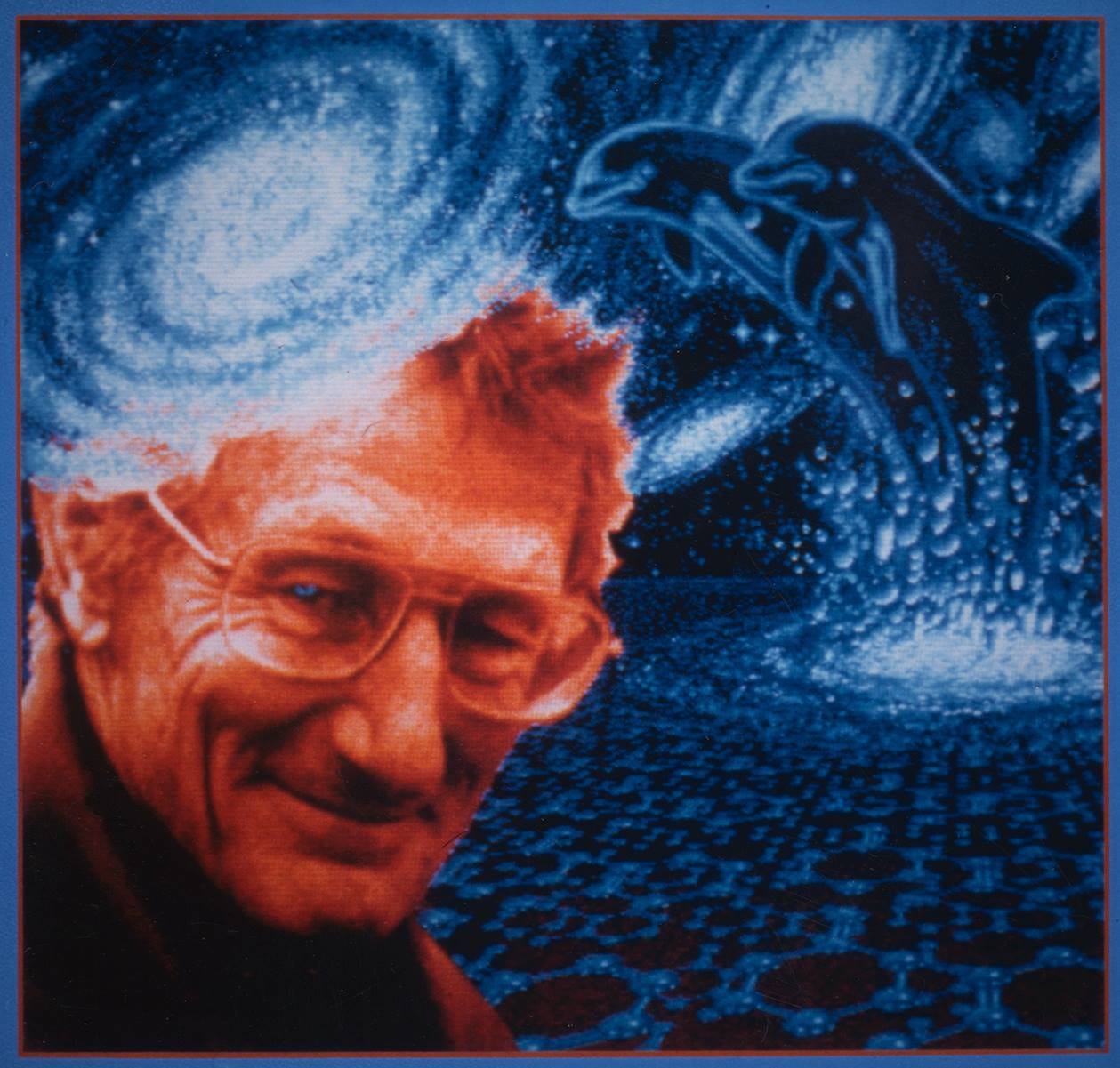
Dr. John C. Lilly was, by any estimation, a mad scientist. After reading Brave New World at an impressionable age, he became interested in neurophysiology, neuropharmacology, and later, human consciousness; as a researcher he is best known for his controversial work on human-animal communication with dolphins. Specifically, most people have heard the lurid stories of human-dolphin intercourse — first via a Hustler article which brought the strange experiments into the public eye, and later via a laundry list of articles on the Internet3. Nonetheless his research was, for a time, legitimate. He began studying the mind as a postdoc at the University of Pennsylvania School of Medicine, and his work on electrical stimulation of the brain helped lay the foundation for the development of neuroprosthetics. He invented the sensory deprivation tank while employed at the National Institute of Mental Health, and he was involved in the SETI alien-search project in the early 60s4. If anything, Dr. Lilly began his scientific career as something of a rising star in the field of medicine. But while at Penn, he was exposed to another infectious idea, one which would become a tenet of his research — that before he could ethically perform an experiment on a test subject, he must first perform it on himself. As his research work increasingly began to involve the use of LSD, he began to consume quite a bit of the drug himself; this corresponds with a deterioration in the academic merit of many of his ideas, culminating in grandiose theories involving cosmic entities in control of coincidence, predictions of a forthcoming war between humanity and electronic devices, and other such nonsensical overcooked-psychonaut delusions.
Biocomputer was written at the inflection point of this downward spiral. Strikingly forward-thinking passages mix freely with psychotic delusions. Large parts of the work – for instance, the chapter entitled “Summary of Experiments in SelfMetaprogramming with LSD25” – might as well have been sourced from Erowid trip reports, and do little to expand on the ideas Lilly presents. In the preface to the first edition, Lilly writes that the work is an attempt “to try and attain objectivity and impartiality with respect to the innermost realities”5, but is objectivity with respect to the innermost realities possible, even in the absence of psychedelic drugs? As anyone who has taken LSD can attest, even the simplest ideas are made to feel profound, and significant logical leaps are made as if they were innately obvious. Lilly himself takes as axiomatic that LSD use increases “suggestibility” in the user.6 These thought patterns are clearly visible throughout the text, with Lilly stringing together far-reaching, seemingly unrelated concepts with dizzying arrays of dashes and commas7. At times he seems to be jotting down random connections he has made during his psychedelic experiences, without any further justification; take for instance the section on the corporeal face, where Lilly maps parts of the body to parts of the face (nipples to eyes, pubes to mouth)8. This is meant as an example of a visual “projection”, on which “one’s own defensive, evasive, and idealization mechanisms can be realized”9, but it is a particularly weak example, comes across as more shocking than enlightening, and is never referred to again within the work.
A larger issue is that of causality. The 1940s were a remarkable time to be an academic, especially at the University of Pennsylvania. The United States’ involvement in World War II led the Army to finance a wide variety of research projects, leading to innumerable developments in the world of science. The most famous of these is likely the Manhattan Project, but there were plenty of other impactful, transformative, and consequential discoveries from this period which have not been made into big-budget Oscar-winning films. For one, in an attempt to speed up the computation of range tables for artillery weapons without requiring small armies of graduate students, the United States Army Ordnance Department contracted professors in Penn’s Moore School of Electrical Engineering to mechanize the efforts via the development of an electronic computer. This project blossomed into the 1945 unveiling of ENIAC, the first Turing-complete, general-purpose digital computer. Four years after this feat, Lilly would be introduced to one of its architects: Britton Chance, a medical professor at Penn affiliated who helped design ENIAC. Lilly’s exposure to these ideas would eventually birth the theory developed in Biocomputer10. Clearly, Lilly did not go into his research with no prior expectation of what he might find. And even if he had, his personal use of LSD during his “experiments” would have led him to overvalue any discoveries he might have made; as he continued his research, his ideas would have continued to reintroduce and reinforce themselves, leading to an ossification of his personal beliefs which would destroy any notion of objectivity. This certainly would explain his later, more nonsensical work, and this process of ideological calcification rears its head throughout Biocomputer, polluting an otherwise revolutionary theory of mind.
So what good is this book, anyways? Although Biocomputer fails to justify or defend Lilly’s theories, it does an excellent job of presenting his ideas and constructing the brain-computer metaphor. All nervous systems are understood to be mechanistic in operation, consisting at the base level of a set of built-in routines – for simpler forms of life, these consist of things like reflexes, instincts, simple muscle movements, and the like. As the environments to which organisms must become adapted grow more varied and challenging, evolution provides new species with new, more complex behaviors. This continuous increase in the specificity and number of the routines available to more complex organisms results in the emergence of a higher layer of programs which control behavior by inhibiting and exciting the built-in routines. Furthermore, as encounters between animals become commonplace, social behaviors and behavioral specializations are developed, which execute programs in specific patterns. Nonetheless, these cooperative behaviors are still programmed into the organisms by evolution. Bees do not choose to become workers, drones, or queens in the same way as humans choose majors in college. The synchronicity of insects working communally in a colony is ultimately built-in – they did not “learn” to act in that way.
But of course, animals can learn. All nervous systems are built around a fundamental maxim: “neurons that fire together, wire together”. If one sort of stimulus is often followed by another, the two become associated. This pattern of cause and effect is the foundation of all learning. Pavlov’s dogs learned to associate the sound of a bell with mealtime, perhaps because food is essential to survival, but in a greater sense because learning itself is essential to survival. If adaptation could only occur through the random chance of evolution, species would be greatly constrained in their possible behaviors. At a certain point, evolution endowed species with the ability to adapt to their surroundings within their own lives, and not merely over time via the survival of the fittest. This process of learning, of changing behavior in response to stimulus, is a program which is capable of changing other programs. It is, to use Lilly’s term, a simple example of a “metaprogram”.
Humans11 take this a step further. We are not merely capable of blindly being conditioned to adapt to stimuli. We categorize and analogize; we make metaphors and moralize; we communicate with one another in languages which are based on abstractions of reality. Here we engage in metaprogramming of a significantly more complex variety. Here, too, we depart from any existing parallel from the world of nervous systems and brains to the world of machines and computers. Simple machines execute routines (grind coffee, boil water). More complex machines are capable of being programmed, and executing different routines based on the program instructions. General-purpose computers are capable of carrying out any algorithm which is provably computable. But behind it all, all the metaprogramming involved is ultimately being carried out by human operators. Within ourselves, though, we are both the metaprogrammer and the metaprogramee – again invoking Lilly’s vocabulary, the “selfmetaprogrammer”. It is at this point within the construction of Lilly’s theory that we find the first glimpse into the nature of our selves. The selfmetaprogrammer at work making plans, resolving, learning to learn, in other words, performing the executive functions, is the “I” within our minds. The personal manner in which we adapt our behaviors to stimuli is the core of our subjective experiences of the world; no soul, indeed no free will at all, is necessary.
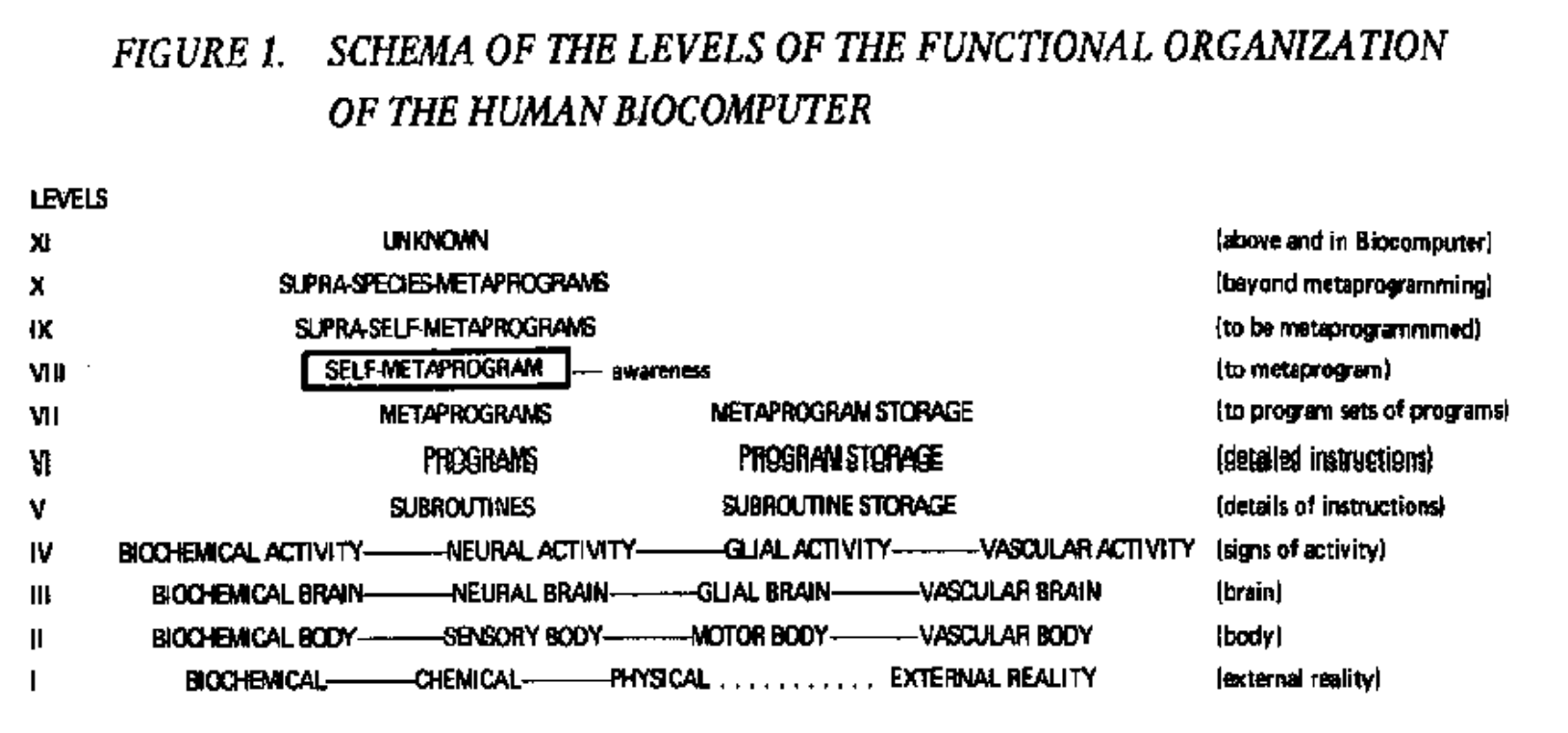
Lilly’s analsyis continues on, to further levels above the selfmetaprogram. The influence of culture and society on the individual biocomputer cannot be overstated. Children are not raised in a vacuum – their modes of thinking are based almost completely on that of their parents, their teachers, their communities, and their society writ large. Indeed, the very languages we use to speak encode specific notions of the world we inhabit (consider the dozens of Eskimo words for snow). These entrenched belief patterns we accumulate throughout childhood constrain our thoughts significantly as we continue into later life. Taboos quite literally become “unthinkable”. Meanwhile, we develop particular notions of what behavior is “rational”, “logical”, or “expected”, which are highly dependent on the cultures we exist in. The clashes that emerge when people from different cultures interact result directly from incompatibilities in their metaprograms. We lose the ability to “read each others’ minds”, because the sorts of thoughts that exist within those minds do not resemble one another. Only highly diplomatic, flexible, and tolerant minds are capable of transitioning smoothly between these different metaprograms – these are the truly general-purpose biocomputers.
Hardly any of this stuck with me on the first read. In fact, I don’t think I made it beyond the first chapter. Enough of the outline of the theory was contained within the prefaces anyways, and given the nonsense I later found throughout the book, maybe it’s best that things shook out that way. What I ultimately took away from Lilly’s ideas was simple, yet compelling – even if our brains are not exactly computers, the metaphor is still a useful lens to try and understand their mysterious workings. Certainly we have found success going the other way. Most, if not all, of the myriad developments in the field of artificial intelligence, all the way back to the lowly perceptron, take their inspiration from our own nervous system.
As I progressed through my later college years, the spark Dr. Lilly provided me guided my choice of electives, and in classes on machine learning and neural networks I found myself again and again considering instead the neural network within my skull. In the midst of a lecture on convolutional neural networks, the key to image recognition, the interdisciplinary bridge was first rendered to me in sharp focus. We developed this structure by studying our own visual systems, and in doing so created a sandbox for experimentation in the reverse direction. As we continue to explore the mind, we will benefit from further interdisciplinary connections of this form, and I believe much can be gained from studying the brain both on the “hardware” level as a remarkably complex, naturally evolved circuit, and on the “software” level as a collection of routines, programs, and metaprograms.
What has emerged for me upon my return to Lilly’s work is the potential for developing insights into the nature of the mind from seemingly unusual sources. After college, I spent a couple years completely absorbed in my new industry, largely removed from the academic pursuits of my college years. The company I work for finds little use in AI modeling, as the lack of explainability and predictability in the outputs it generates can be especially dangerous in the financial markets. But I did develop an interest in Russian literature after strong and repeated encouragement from my dad to read Crime and Punishment. So imagine my surprise when I returned to Biocomputer and found excerpts from Dostoevsky’s The Idiot waiting for me at the end! The “idiot” protagonist, like Dostoevsky himself, suffers from the “sacred disease”, epilepsy, and one passage contains a detailed description of the moment of onset of seizure. The extreme feeling of clarity and awareness – the “highest mode of existence”12 – which precedes the seizure was undoubtedly seen by Lilly as a severe moment of mental reprogramming, similar in form if not in magnitude to what he himself felt in his experiences with LSD. And while I personally did not find much more to learn about the brain within the pages of The Idiot13, there is plenty to be uncovered by reading other works of literature. This is particularly true in older works, which could potentially represent human minds at earlier points in the evolution of the pattern of thought we recognize as consciousness14.
And, of course, one extremely obvious conclusion stands out from Biocomputer. Perhaps it is immoral to conduct an experiment on a volunteer which you have not first conducted on yourself. But it is certainly worse to make self-experimentation a habit, especially when dealing with the nature of one’s own mind, and even more so when conducting this research using powerful, mind-altering substances! Reading this book for what will likely be the final time, I wondered how things might have been different had Lilly never tried LSD, or only used it a few times before focusing back in on his research. Would he have developed a more complete, scientifically sound theory? Or would he never have developed these ideas at all? Would his star have continued to rise, inspiring more, similar research, leading to a new cultural understanding of the nature of our minds? Would we have seen the same governmental backlash to psychedelic drugs if not for mad scientists like Lilly? Ultimately, we can only know what has happened, and not what could. Lilly conducted more unscientific research, developed more crackpot theories, and died having largely faded into obscurity. But the embers of his greatest idea smoldered just enough to be noticed by Abizer, through whom they found their way to me, and now finally on to you.
The second introductory CS class I took at Cal had 2,000 students, and the first couple lectures had to be held in Zellerbach Playhouse. The instructors encouraged the students to watch the lectures online, and not attend in-person, so I proceeded to never attend any of my CS lectures for the rest of college, and self-teach the material from the notes and course materials; this is why none of my professors know (or likely ever knew) who I am.
After a semester, I joined the “opstaff” of the OCF, which was a separate position from just being in the club — a paid position, consisting of the people who checked IDs, fixed paper jams, and answered questions. Despite being paid to be there, the opstaff still spent just a fraction of the time the old heads spent in the lab.
Due to the sexual needs of the dolphin, and the fact that the dolphin and the (female) human trainer, Margaret Howe Lovatt, lived together full-time in a partially flooded home called the “Dolphinarium”, Lovatt would regularly masturbate the dolphin. In Lovatt’s words, “it would just become part of what was going on, like an itch, just get rid of that scratch and we would be done and move on.” Lilly, using the term “interlock” to refer to the human-dolphin relationship, defends the practice in Biocomputer: “such interlock participation and realistic model building and rebuilding… assumes interlock in most areas… even in those areas forbidden to western ‘civilized man.’” (Lilly, “Programming and Metaprogramming in the Human Biocomputer”, Second Edition, p. 108; the Lovatt quote is sourced from her Wikipedia page.)
In fact, he led a group of scientists in this work who referred to themselves as The Order of the Dolphin.
Lilly, “Biocomputer”, p. xi (all page references are to the Second Edition)
Lilly, “Biocomputer”, p. 91
For instance, consider this paragraph:
The introduction of open-minded, multiple-level, continuously developing, online, operational, dynamic, economical, expanding, structural-functional, field-jumping, field-ignoring theory is needed. The applications of this theory extend from the atomic-molecular-membranes-cell levels, through cell aggregational levels, total behavior and mental-cognitive levels of the single organism of large brain size, and to dyadic and larger groups of such individuals. (Lilly, “Biocomputer”, p. 2-3)
Lilly, “Biocomputer”, p. 24
Lilly, “Biocomputer”, p. 21
In the foreward (sic) to the second edition of Biocomputer, Lilly writes:
I coupled these ideas back to my own software through the atmosphere of my neurophysiological research on cerebral cortex. It was more fully elaborated in the tank isolation solitude and confinement work at NIMH from 1953 to 1958. (Lilly, “Biocomputer”, p. i-ii)
And maybe other, particularly intelligent animals (e.g. crows, octopi, great apes), hence the dolphin research.
Lilly, “Biocomputer”, p. 140; this is of course in actuality a quote from “The Idiot”, but I don’t have my copy handy to find the page number.
That said, it’s an excellent analysis of the limits of morality and innocence, approached from a completely different perspective than the more well-known Crime and Punishment; it also has a stimulating love-triangle subplot, which together make it one of my favorite Russian novels I’ve read so far.
I am alluding here to the book which has influenced my thinking on this topic more than any other, Julian Jaynes’ The Origin of Consciousness in the Breakdown of the Bicameral Mind, of which I will have much, much more to say on this blog in the future. Jaynes is of the belief that consciousness as we understood it today is a relatively new phenomenon, at most 3000 years old.